Entry-level vs advanced Sonicare – which one actually makes sense?

If you’re comparing the Sonicare 4100 vs Sonicare 6100, you’re looking at two very similar electric toothbrushes – but from different segments of the product line.
In other words:
👉 This is a budget vs premium decision you’re making.
Both models are solid performers. Both are part of Philips Sonicare’s mid-range lineup. Both are designed to improve gum health and plaque removal compared to using a manual toothbrush.
But with a significant price difference between them, many people wonder:
- Is the 6100 significantly better than the 4100?
- Does it clean more effectively?
- Is the upgrade worth paying more for?
The short answer:
For most users, the Sonicare ProtectiveClean 4100will be more than enough. The Sonicare 6100 model offers more features and greater convenience, but not very different cleaning power.
In this side-by-side comparison of the two stellar electric toothbrush models, we’ll break down the differences clearly.
After you compare cleaning performance, pressure sensors, brushing modes, ease of use, and real-world value, you can decide which one is right for you.
And then, if you’d like to cast your net even wider, explore our detailed analysis of the best Sonicare toothbrush models.
(Last Updated: 21st March 2026)
Quick Decision Summary
- You want cheapest solid cleaning
- You don’t need extra modes
- You want more cleaning modes
- You want choice of brushing intensity
👉 Most users should choose a Sonicare 4100 unless you need intensity and mode options (due to sensitive teeth or receding gums) – or want a premium model.
Not yet sure?
👉 Read the detailed Philips Sonicare 4100 review.
👉 See the full Sonicare ProtectiveClean 6100 review.
⚔️ Related Comparisons
Sonicare 4100:
Sonicare 6100:
- Sonicare 6100 vs 7500
- Sonicare 5100 vs 6100
- Sonicare 6100 vs DiamondClean
- Sonicare 6100 vs 9900 Prestige
With the Philips Sonicare ProtectiveClean 4100 you get
- effective cleaning,
- a pressure sensor, and
- the best value without extra modes.
With the Sonicare ProtectiveClean 6100 you’ll enjoy
- BrushSync technology for better tracking,
- enhanced brushing feedback, and
- a slightly more premium experience.
Both models use the same core sonic motor system. The Sonicare 6100 adds a few usability upgrades – but is not really stronger in cleaning power.
In this Sonicare 4100 vs 6100 analysis, let’s see what makes each so special – and decide which Sonicare toothbrush is best for you.
- If you’re on a tight budget, check out the best Sonicare under $100.
- For a slightly higher price, you can upgrade to the Sonicare 7500 – or even a Sonicare 9900 – and enjoy greater value. (See this Sonicare 6100 vs 7500 comparison.)
- Read our analysis of whether Sonicare is worth it overall.
Comparison Table: Sonicare 4100 vs 6100
| Feature | Sonicare 4100 | Sonicare 6100 |
|---|---|---|
| Sonic Cleaning Technology | Yes | Yes |
| Brush Strokes Per Minute | Up to 31,000 | Up to 31,000 |
| Cleaning Modes | 1 (Clean) | 3 (Clean, White, Gum Care) |
| Intensity Settings | 1 | 3 (Low, Medium, High) |
| Pressure Sensor | Yes | Yes |
| Brush Head Replacement Reminder | No | Yes (BrushSync) |
| Battery Life | ~2 weeks | ~2–3 weeks |
| Travel Case | Usually included | Usually included |
| Typical Price | Lower | Higher |
Don’t Overpay For Smart Features
Do the Sonicare 4100 and 6100 clean differently in real use?
In terms of cleaning power, the answer is: No, not meaningfully.
Both models use Philips Sonicare’s signature sonic technology. The rapidly oscillating brush heads generate up to 31,000 brush strokes per minute.
That motion sets up a sonic vibration that disrupts plaque and cleans along the gumline effectively – no matter which handle you choose.
In practical use, in the Sonicare 4100 vs 6100 comparison:
- Plaque removal is just as effective
- Gumline cleaning performance is comparable
- Overall brushing effectiveness feels very similar
In everyday brushing, most adults would struggle to notice any meaningful difference in plaque removal between the two handles.
If your priority is core cleaning performance alone, either model will serve you well. So don’t overpay for smart features that you might never use!
You may not find any significant benefit from upgrading to a 6100 – unless you have special needs, like sensitive teeth. or wearing braces. or receding gums.
But if you do, then the modest extra amount you’ll invest into a Sonicare ProtectiveClean 6100 is completely worth it for options like varying brushing intensity and extra modes.
Compared: Cleaning Modes and Intensity Settings

This is one of the biggest differences between the two:
Sonicare 4100
- 1 cleaning mode (Clean)
- 1 intensity level
This simplicity is part of its charm. Just press the button and brush. For many users, especially those new to electric toothbrushes, such a single-mode approach is easier to use, and less confusing. See the Sonicare 4100 review.
Sonicare 6100
- 3 cleaning modes (Clean, White, Gum Care)
- 3 intensity levels in each (Low, Medium, High)
This allows more customized tailoring of your brushing routine:
- Lower settings if your gums are sensitive
- Higher settings if you prefer a stronger feel
- Dedicated modes for whitening or gum care
However, having more modes and intensity does not automatically translate to better overall cleaning. They simply offer more options. See the full Sonicare 6100 review.
Pressure Sensors and Gum Protection: Is There a Difference?
Both the Sonicare 4100 and 6100 include built-in pressure sensors that alert you when you’re brushing too hard. This feature is genuinely helpful in preventing gum recession and enamel wear-out.
Where the Philips Sonicare 6100 electric toothbrush has a slight edge is in how it integrates with a choice of extra modes. When you’re using Gentle or Gum Care mode, it’s easier to stay in a comfortable range without having to adjust pressure too much.
But in routine daily use, both models will protect your gums effectively.
BrushSync and Replacement Reminders: Sonicare 4100 vs 6100

This is one area where the Philips Sonicare 6100 adds convenience:
- 4100: Does not have BrushSync tracking
- 6100: Includes BrushSync brush head reminders
BrushSync tells you when to replace the brush head based on usage – which means less guesswork. You don’t need this feature to brush effectively, but many users find it helpful as a reminder.
It also automatically matches the type of brush head to its optimal mode, which lets you enjoy the best value from your brushing experience.
Battery Life and Build Quality Comparison
Both models offer solid battery life. They will last roughly two weeks on a full charge with typical use.
The Sonicare 6100 may boast slightly longer battery life depending on settings and travel case configuration, but in everyday life the difference is minimal.
Overall build quality feels similar: sturdy, ergonomic handles with reliable charge performance.
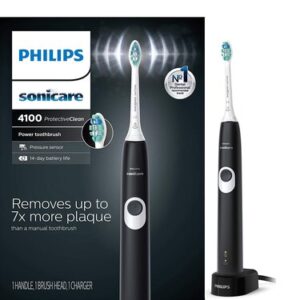
Who Should Choose the Sonicare 4100?
The Sonicare ProtectiveClean 4100 is a great choice if you want:
- A straightforward electric toothbrush
- Effective sonic cleaning without extras
- A lower-cost entry into Sonicare technology
- Less complexity in settings and modes
If you’re new to electric toothbrushes or simply want effective cleaning with pressure protection, the 4100 delivers reliably.
If budget is your main priority, you might also explore our guide to the best Sonicare under $100.

Who Should Choose the Sonicare 6100?
The Philips Sonicare 6100 is more suitable if you:
- Want adjustable intensity levels
- Prefer dedicated modes for gum care or whitening
- Appreciate brush head replacement reminders
- Enjoy some customization in your brushing routine
It doesn’t clean better, but it gives you more control.
If you’re considering models in this price range, you may also want to compare the 5100 vs 6100 before deciding.

Is the Sonicare 6100 Worth the Upgrade from the 4100?
Whether the Sonicare 6100 is worth upgrading to depends on how much you value customization:
- If you prefer simplicity and the lowest cost, the 4100 wins out.
- If you want flexibility and additional brushing options, the 6100 can feel like a worthwhile upgrade.
You’re paying for extra features – not a significant jump in cleaning performance.
If you’re wondering how far up the range it makes sense to go, see our comparison of the 6100 vs 7500.
Final Verdict: Sonicare 4100 vs 6100
Both are highly capable electric toothbrushes with strong plaque removal and gum protection.
The Sonicare 4100 model is often the smarter buy for most people: simple, effective, and excellent value. For more details, see our in-depth Philips Sonicare 4100 review.
The Philips Sonicare 6100 adds customization and reminders that some users appreciate – especially those with gum sensitivity or a desire for specific brushing modes. Learn more about this model in our detailed Sonicare 6100 review.
- If you value simplicity and price efficiency, choose the 4100.
- If you prefer customization and flexibility, the 6100 is a reasonable step up.
FAQ: Sonicare 4100 vs 6100
1. Is the Sonicare 6100 more powerful than the 4100?
No – both use the same sonic motor system and provide similar cleaning performance.
2. Do they both have pressure sensors?
Yes – both models include pressure sensors to prevent over-brushing.
3. Does the 6100 remove plaque significantly better?
No – plaque removal capability is nearly identical between the two.
4. Is the Sonicare 6100 better for sensitive gums?
Both models offer pressure protection and intensity options; comfort is similar.
5. Is the 6100 worth the extra money?
It depends on whether you value brushing modes, intensity levels, and replacement reminders more than simplicity.